EXPERIENCE
20+ years of experience delivering results at the intersection of development, data, and digital innovation.
Led the 14 country USAID Philippines, PNG Pacific Islands, and Mongolia, Monitoring and Evaluation Learning Activity. (USAID PIMMELA). Backstopping an interdisciplinary team of senior experts to achieving USAID’s Indo Pacific regional goal through 5 key components. (Read the CPAR excerpt on my leadership in the media below.)
Component 1: Performance Management Data Collection, Reporting and Analysis
Component 2: Third Party Monitoring and Verification Services
Component 3: Evaluation and Research Services
Component 4: Collaboration Learning and Adaptive Services (CLA)
Component 5: Office of Health Monitoring, Evaluation, Reporting, Research, Learning and Analysis (MERRLAA) Services.
USAID programming is implemented in Philippines with a combination of 12 Pacific Island (PI) countries: Federated States of Micronesia (FSM), Fiji, Kiribati, Nauru, Palau, Papua New Guinea (PNG), Republic of the Marshall Islands (RMI), Samoa, and Solomon Islands, Tonga, Tuvalu, and Vanuatu. Mongolia is also supported by this activity. I provide strategic and technical direction for a larger team of interdisciplinary research, MEL and Program specialists in providing strategic directions for USAID Programming in the Indo Pacific.
Provided multi country management and advisory support and guidance to the Indo-Pacific Cyber Programme Work Stream 5 on Cyber Skills & Awareness. Providing need based MEL guidance, review and capacity building for National Cybersecurity Agencies in Indonesia, Thailand, Malaysia and Philippines.
Key Achievements –
Designed, led and executed training modules on Cybersecurity for Satu Sehat (One Health) app for Digital Transformation Office of the Ministry of Health
Designed, Led and executed trainings for SMEs in Indonesia on Cybersecurity through the National Cybersecurity Agency (BSSN)
Designed and developed Technical Guidance on Cybersecurity for FINTECH sector for OJK (Indonesian tax authority).
Designed and developed Technical Guidance on Cybersecurity for Crypto Exchanges for OJK (Indonesian tax authority).
Chief of Party for the USAID Monitoring, Evaluation and Learning Services Support Activity (MELSA) task order and leads interdisciplinary team, spread across Southeast Asia. Provides Management oversight and Technical support in MEL, Innovation, and Research for USAID across four CLINS. Supported 46 service requests, and received excellent CPARs and consistent appreciation from the USAID. Grew the portfolio 5 fold and built systems and teams to support the 4 CLINs.
This includes strengthening USAID Mission systems and capacity related to indicator setting, monitoring, data analysis and results reporting (CLIN001), conducting performance and/or impact evaluations and disseminate evaluation findings (CLIN002), supporting mission’s capacity in developing and implementing Collaborating, Learning and Assessment (CLA) systems (CLIN003), and providing the Mission with analytical reports, as needed (CLIN004). Specific tasks including but not limited to, full Country Development Cooperation Strategy (CDCS) development support, remote monitoring, mid-term and final performance evaluations, initial MEL assessments and analyses, complexity aware monitoring, data quality assessments, political economy analysis, and data quality verification. Also support the implementation of a scenario-based programming approach that includes context monitoring; support for routine performance monitoring tasks, including maintaining and updating the Mission Performance Management Plan (PMP), activity MEL plans, and indicator collation and analysis; MEL training for USAID staff and partners on pertinent topics; and the integration of knowledge management and learning across the USAID Mission portfolio.
Part of IAEA’s Internal Oversight services Team’s expert panel reviewing effectiveness of the Agency’s Inter Regional and Regional Cooperation Mechanisms including site visits to Nuclear facilities in Indonesia and Vietnam.
Supported the Safe Online pillar’s Eval needs including grantee selection, MEL framework and guidance. Convened the Evaluation Advisory group.
Senior Technical Expert – Result and Performance Analysis (Apr 2021 – Des 2021) Involved in the write up of RAP 2021, World Bank IEG’s flagship product that reviews all WB investments and measures success and maps outcome journeys. Keys tasks include: Analyze World Bank Group project documents to extract and code information related to outcomes, projects, and risk; – Produce problem-driven research on what factors explain the WBG big picture ratings trends for its portfolio performance over the last 10-year period. This will involve hypothesis testing and analysis across many data sources, analysis of WBG performance data, and production of written documentation of the analysis undertaken (technical notes, annexes, etc.); Provide mixed methods analytical support to TTL. See more
Conducted and published a multi region digitalization capacity assessment through NIRAS Sweden to aid Swedish Government’s (SIDA) digital strategy for Africa.
Led the development of a technology for development solution for the Ministry of Villages. Conducted an organizational capacity assessment of the Ministry, and provided strategic recommendations for digital tools for management of the Ministry’s village intervention. Led the development of a mobile based application. Worked within the Social, Urban and Rural Resilience Global Practice.
Project 2: Setting up the baseline study for a multi partner, multi sectoral project in South Sumatra for The project is aimed at building partnership to preserve peatlands in Indonesia. Involved in developing log frames, theory of change, indicators and control and experiment groups for nearly 14000 households.
Project 3: Setting up impact evaluation of a coastal conservation NGO’s work over last 3 years through agro ecological data and qualitative surveys using primary data as well as through Third Party Monitors.
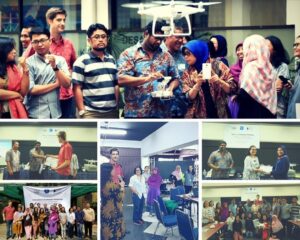
Project 4; Leading a project that is working on expanding use of drones in Indonesia and Kenya by NGOs, Government bodies and students of agriculture, development and technology. Particularly working with rice farmers in Southern Bali. Involved in Multistakeholder Policy Formulation and Action Planning (MPAP) assessment in East Africa and SE Asia for the use of Drones and UAVs
– Involved in using Drones for Evaluating project impacts.
– Developing curriculum for drone training that includes
– Using drones for 3D mappings in precision farming landscape planning
-Strategies in more effective water management with existing technologies
-Rapid fleet deployment for emergency response
– Developing partnerships with governments, NGOs, donors and conservation groups.
– Developing protocols for training and operation of drones.
– Developing ICT based training modules in collaboration with local universities and the Indonesian Evaluation Association.
Project 5: Developing MIS Systems and MEL Framework for DFAT Funded KOMPAK – Governance for Growth project as Senior Advisor.
Project 6: Developing M&E system for GIZ Indonesia Developing ICT4D Tools and Apps for use in the development sector, including IoTs and wearable tech for farmers. See more
Team Leader/Senior Evaluation Advisor, USAID Country Development Cooperation Strategy. Leading the external evaluation team that is conducting a performance evaluation of USAID Zambia’s entire country portfolio (CDCS) covering 45 projects including Health, Education, Women and girls Empowerment, Democratic rights and Governance and Economic Improvement, Food security and Climate Change. Involved in managing a multi-cultural, multi country team, developing proposal, M&E protocols, budgeting, Methodology development, Tool development, Training, Analysis and Reporting.
Project 1: Africa Rising, part of USAID’s Feed the Futures Project leader and Principal Investigator for IWMI component. Involved in developing research methodology for evaluating impact of multi stake holder farm level interventions across three regions of Africa, implementing household based approach to improve livelihood outcomes including health, training and capacity building of project staff and local partners. Introduced solar technology and other innovations within the process site, hitherto untested in Ethiopia. Creating ICT4D tools for sustainable intensification. Involved in Donor reporting, recruitment and management of consultants and a large team of interdisciplinary staff. See more
Project 2: LIVES (http://lives-ethiopia.org/) Measuring Livestock and Irrigation Value Chains with a Gender Lens Training and Capacity building of project staff and local partners Development and implementation of Participatory Rapid Diagnosis and Action Planning Manual Creating ICT based database for knowledge transfer to farmers through mobile phones. See more
Project 3: Humid Tropics (http://humidtropics.cgiar.org/) Involved in developing livelihood typologies and livelihood characterization. Impact evaluation of interventions. See more
Project 4: Capacity Development of local partners. Developing and implementing strategy for building local capacity in research, fund raising, ICT tools for research, M&E techniques, Gender integration at organizational and individual levels for local partners from Governments, NGOs and other stakeholders. See more
Key Roles:
• Project management, recruitment and training of Researchers
• Training on Sustainable Development, ICT4D and Livelihood strategies to UNZA Researchers.
• Developing and Training on M&E tools pertaining to USAID Norms.
• Capacity building for effective data collection using innovative ICT based tools.
• Recruit and train in country staff for the project.
• Research methodology development and implementation of a large scale RCT Trial across Zambia.
• Analyzing data and leading publishing and dissemination of results.
• Mentoring close to 200 local partners in data collection and analysis.
• Transitioning greater research management responsibility to the local partners.
• Liaisoning with USG, program staff, and research staff working across organizations to carry out the evaluation and build evaluation capacity.
• Liaison with Zambian government ministries and other stakeholders in the evaluation and implementation to turn research to practice.
• Supporting use of information among program staff and Government at all levels.
Additional Assignments: Setting up Plan International’s PACE database an M&E tool for collecting Child Sponsorship data. Tutoring for an E Course on ICT based tools for M&E, Project Implementation and Policy change. See more
Providing direction guidance on inter-disciplinary panel of development practitioners engaged in Sustainable Livelihood Approaches in Theory and Practice. Members include NGOs, Governments, Academics, Policy Makers and Donors
I was head of research at IRRAD, a grassroots research organization working in Mewat, Haryana. My main responsibility was to evaluate impacts of IRRADs programs on water, health, Life Skills Eduation and Agriculture Management. I also set up the research centre to a fully functional think tank and brought in external funding.
Visiting Scientist (2008 – 2009)
for the Global Theme on Institutions, Markets, Policy and Impacts. International Crops Research Institute for the Semi Arid Tropics (ICRISAT) Involved in two projects:
– Tracking rural poverty in fragile lands and identifying coping strategies of poor households (particularly rural – urban migration) in response to shocks. (Gates Foundation funded). Particular focus on identifying the impacts of HIV/AIDS on rural households.
– Identifying Vulnerability, Adaptation and layers of resilience to climatic shocks (ADB Funded)
Involved in setting up research questions, designing tools for data collection and analysis, research management and training and involved in actual fieldwork, analysis and publications.
Research Scholar (2003 – 2008)
Worked on PhD thesis on Vulnerability Assessment in Marginal Lands focus on on Migration and HIV/AIDS linkages and its impact on Poverty
Human Development Network, Social Protection Unit (HDNSP),
The World Bank. (Jointly with University of Oxford)
Lead researcher for the qualitative research team for South India for a study entitled “Addressing Extreme Poverty in Low Income Countries: Balancing Prevention and Protection”. This component is a part of a three-country study (India, Nicaragua and Ethiopia) conducted in collaboration with University of Oxford. Drawing on existing panel data (ICRISAT’s Village Level Studies) and findings from primary qualitative data, the study examines the hypothesis that ex ante and ex post risk management strategies vary significantly according to the socio-cultural and public services contexts; and that effective programming relies on recognition and appropriate planning for specific settings.
The focus was on identifying livelihood strategies, policies, programs and technologies that help poor households cope with unforeseen events such as climatic shocks, and thus prevent them from descending into extreme poverty, as well as more focus on addressing structural factors that create barriers to upward mobility. The study focuses on the factors that affect both and men and women.
Roles and responsibilities:
Lead researcher for south India: involved in all stages of the research process;
– Development and field testing of qualitative research instruments,
– Development of research manual to be used in all three country studies.
– Selection and training of research assistants.
– Managing the budget and fund allocation for each activity
– Direct supervision and participation in the intensive fieldwork using qualitative research tools in six case study (ICRISAT’s VLS) villages.
– Analysis of data and write up of India Case study report.
– Collaborate and contribute for final paper along with quantitative team (University of Oxford)
Professional Moments